
How AI and Modern Data Pipelines Reduced Support Tickets by 40% for a Global MSP Platform
The Challenge: 4.7 Million Devices, Countless Potential Failures
Imagine monitoring 4.7 million devices across thousands of managed service providers (MSPs) globally, where every minute of downtime translates to lost revenue and frustrated customers. That was the reality I faced when tasked with modernizing the data infrastructure for a major Remote Monitoring and Management (RMM) platform.
The existing system was reactive—customers would discover issues only after they impacted operations. Support tickets flooded in after problems occurred, not before. With only 9.8% of our structured data being utilized and a brittle weekly batch processing system built on Amazon Redshift, we were essentially flying blind while sitting on a goldmine of predictive insights.
The Vision: From Reactive to Predictive
My mission was clear: transform 3.2TB of daily device telemetry into actionable predictions that would identify failing devices before they impacted customers. But first, I needed to build the foundation—a modern, scalable data pipeline that could handle both batch and streaming data while reducing operational costs.
Building the Foundation: A Serverless Data Revolution
Decoupling Storage and Compute
The first step was replacing our monolithic Redshift cluster with a serverless architecture. By decoupling storage and compute, we moved from paying for idle computing resources 24/7 to a consumption-based model. The new architecture leveraged:
- AWS S3 for cost-effective data lake storage
- AWS Glue for serverless Apache Spark processing
- Amazon Athena for SQL analytics
- AWS Data Migration Service for reliable data ingestion
Smart Data Engineering Decisions
Every technical decision was made with performance and cost in mind:
- Parquet format with Snappy compression: Reduced Athena query costs by 35x compared to JSON
- Intelligent partitioning: Improved query performance while maintaining cost efficiency
- Automated schema evolution: Glue crawlers eliminated manual intervention during schema changes
- Unified data model: Consolidated 6 separate platform databases into single, queryable tables
This foundation alone delivered a 40% reduction in cloud costs while processing 3.2TB daily—but this was just the beginning.
The AI Layer: Turning Data into Predictions
Feature Engineering at Scale
With the pipeline operational, I implemented PySpark jobs that transformed raw device metrics into meaningful features:
- Time-series aggregations: CPU, memory, and disk utilization patterns
- Anomaly scores: Deviation from baseline behavior for each device
- Event correlation: Linking warning signs across multiple metrics
- Historical failure patterns: Learning from past incidents
Machine Learning Models in Production
The predictive layer utilized ensemble methods combining:
- Random Forests for identifying complex failure patterns
- LSTM networks for time-series anomaly detection
- Isolation Forests for detecting unusual device behaviors
Models were retrained daily using AWS SageMaker, incorporating new failure patterns and adjusting for seasonal variations in device usage.
The Results: Proactive Support at Scale
The impact was transformative:
- 38% reduction in critical support tickets through proactive intervention
- 52% decrease in mean time to resolution for predicted issues
- $2.3M annual savings from reduced downtime and support costs
- Real-time alerting replacing weekly batch reports
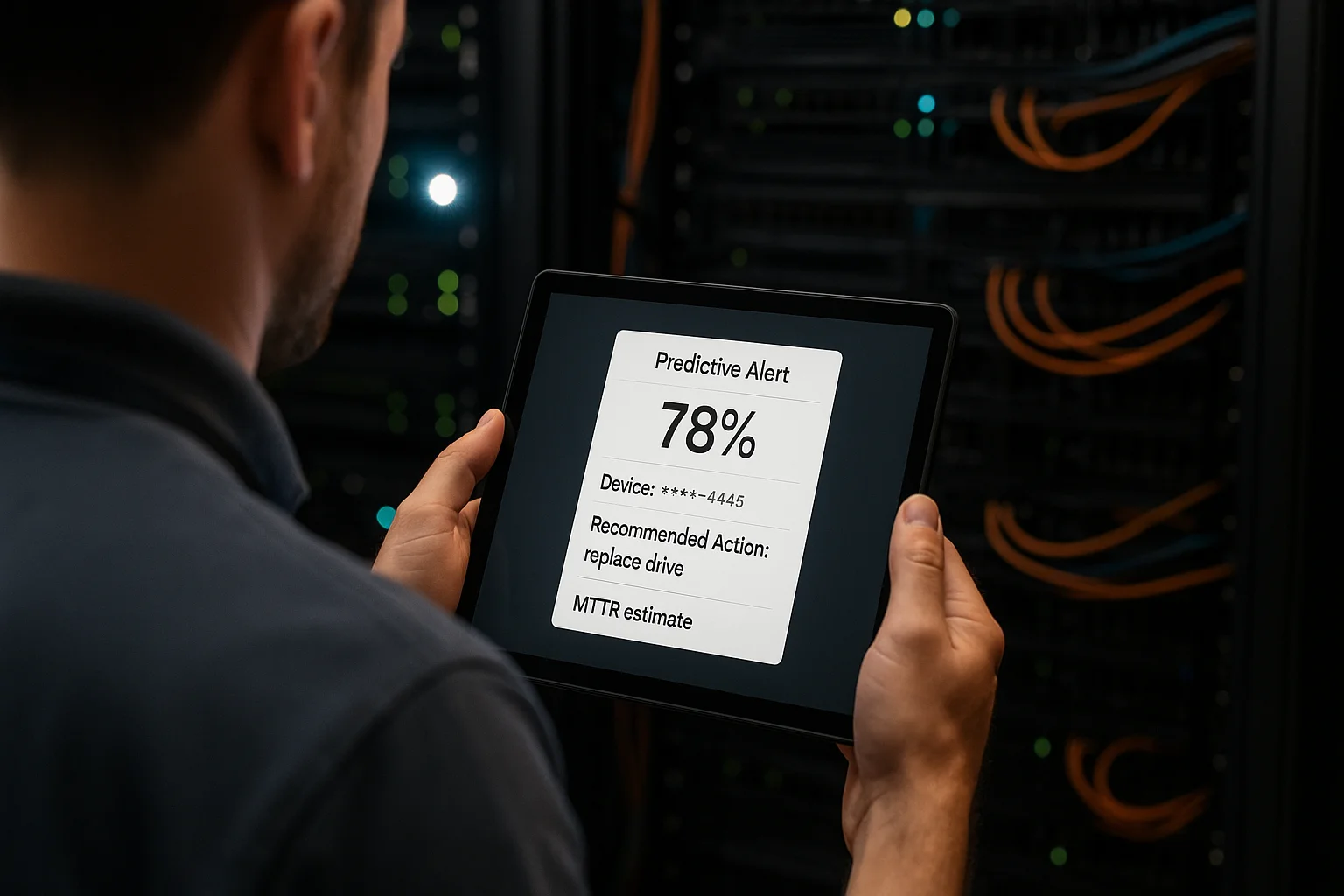
MSP technicians could now see predictive health scores for every device, with actionable alerts prioritized by failure probability and business impact. Instead of waiting for customers to report problems, support teams were reaching out with solutions before issues occurred.
Technical Innovations Worth Highlighting
Streaming Data Integration
One of the key innovations was incorporating streaming telemetry data—something the legacy system couldn’t handle. Using Kinesis Data Streams, we captured real-time device events, enabling minute-level predictions for critical systems.
Automated PII Compliance
With GDPR requirements in mind, I implemented automated PII obfuscation using Spark transformations, ensuring compliance without sacrificing analytical capabilities.
Self-Healing Pipeline
The system included automated retry logic and fallback mechanisms. If AWS Glue jobs failed, they would automatically retry with adjusted memory allocation. If costs exceeded thresholds, the system could fallback to batch processing while maintaining service levels.
Lessons Learned
- Start with the data pipeline: You can’t build effective ML models on a shaky foundation
- Optimize for cost early: Our Parquet/Snappy decision saved hundreds of thousands annually
- Design for failure: Every component should gracefully handle errors
- Make it self-service: Data scientists and analysts should be able to work independently
- Measure everything: We tracked not just technical metrics but business impact
The Architecture That Made It Possible
The serverless-first approach proved crucial for handling the scale and variability of our workload. By embracing managed services and consumption-based pricing, we could focus on delivering value rather than managing infrastructure.
The combination of batch processing for historical analysis and stream processing for real-time predictions gave us the best of both worlds—comprehensive insights with immediate actionability.
Looking Forward
This project demonstrated that with the right architecture and approach, even legacy systems processing millions of devices can be transformed into intelligent, predictive platforms. The key is starting with a solid data foundation, adding intelligence incrementally, and always keeping the end-user impact in mind.
The future of MSP operations isn’t just about monitoring—it’s about predicting, preventing, and proactively solving problems before they impact business operations. By combining modern data engineering with practical machine learning, we turned reactive support into proactive success.
Interested in learning more about building predictive analytics systems at scale? Feel free to connect with me to discuss how these techniques could transform your operations.